

Greek Life Crisis Management
Posted: September 28, 2015, at 2:05 p.m.
by Sally Immel.
The increase in the number of college students choosing to “go Greek” has caused sorority and fraternity leadership to assemble a set of rules and regulations to ensure that each chapter is managed efficiently. With the increasing size and media attention, how are Greek organizations today handling crisis management in the unfortunate event of a tragedy?
Currently, there are 123 fraternities and sororities that have established 12,000 chapters across 800 campuses with 750,000 undergrads and 9 million total members. This increase in membership has caused many chapters to manage their organizations more like corporations that must run like a well-oiled machine in order to be successful. Various protocols are set in place to preserve traditions in chapter meetings, initiation services, recruitment voting, etc.
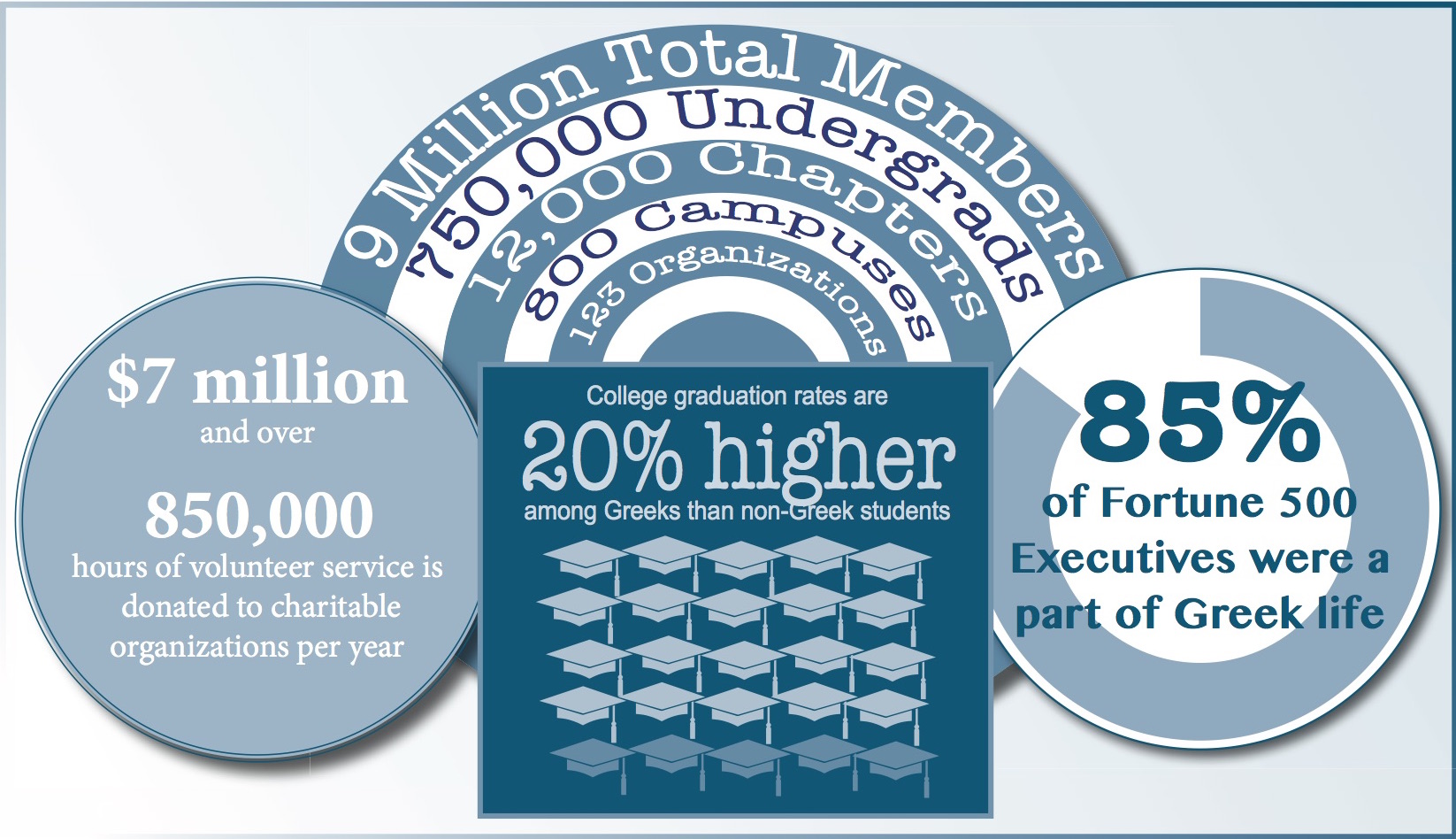
Greek life has been a part of college campuses for more than 200 years, and most Greek-affiliated alums will tell you that joining a fraternity or sorority was the best decision of their college career. College graduation rates are 20 percent higher among Greeks than non-Greeks, and 85 percent of Fortune 500 executives were a part of Greek life. The Greek system is the largest network of volunteers in the United States, with members donating over $7 million and 850,000 hours of volunteer services each year. As members of a Greek organization, actives are given the opportunity to develop skills in networking, leadership, problem solving, social interaction and many other areas that will help them to be successful young professionals upon graduation.
Most of the positive aspects of Greek life are overridden with increased media headlines associated with hazing scandals, sexual assault crimes, racial issues and parties that promote underage binge drinking. At least one hazing-induced death per year has been reported across college campuses for the past 40 years. This statistic leaves a cause for concern and an increase in necessity for risk management.
The risk management plan of each organization has progressively become one of the most important protocols to safeguard against tragedy striking. Even with a foolproof risk management plan, mishaps are bound to happen, and that is when a crisis management plan is crucial for the organization’s survival.
Michelle Bower from Dittoe Public Relations for the National Panhellenic Conference (NPC) said that the NPC has an official crisis management strategy in place that details internal and external contacts, sample messaging, legal steps if necessary and more.
Within the crisis plan, the NPC has brainstormed and identified various possible scenarios that could arise and how they would handle each of them. There are designated executive board members who handle specific topics and who are prepped and ready. They have created sample Q&As to prepare for media interviews and public response, along with prepared social media posts and other forms of communication.
“We can never anticipate all of the details of a potential crisis, so there is room for adjustment as each individual situation arises, but many of the basic first steps are outlined,” Bower said.
The NPC provided a crisis management plan template to all of its 26 member organizations in 2012 and encourages them to use it. Most of the individual member groups also have their own crisis management plan in place that relates specifically to their organization and headquarters.
At times, it is necessary for individual universities to intervene in the crisis management plan of fraternities and sororities. The University of Alabama’s spokesperson for Greek life, Chris Bryant said that the primary goals of the University include: ensuring people have the information needed to protect themselves and make good decisions; and to provide accurate, timely information to key stakeholders using the most impactful methods available. The University also wants to minimize opportunities for negative public relations.”
The national headquarters of each organization leads alumnae currently serving on the advisory board. The advisory board then guides the active members holding chapter council positions, who relay important announcements to the active members of the chapter.
“The safety of our members is of great importance and should be regarded as the most crucial responsibility of a sorority’s officers. Being a part of an organization like ours entails following guidelines and representing yourself in a way that reflects our chapter positively and keeps each member from endangering themselves,” said Margaret Schatzman, president of the University of Alabama chapter of Kappa Kappa Gamma.
Schatzman’s role in the crisis management plan for Kappa Kappa Gamma is to make sure that each chapter member knows the importance of chapter safety and their responsibility to the national fraternity in upholding a positive presence on campus. As a member of chapter council, Schatzman’s duty is to serve as a role model to all active members.
With increasing chapter size and media attention on the negative aspects of an organization’s reputation, an effective crisis management plan is crucial to the success of an individual chapter. The Greek system seems to have a very strong crisis management plan to get their name out of the dark; and it’s almost no surprise that 85 percent of Fortune 500 executives were a part of Greek life.


Opinions
Comments are closed.

Post comment
Risk management in Greek organizations is one of the most crucial components to ensure all fraternity or sorority operations run safely and smoothly. In a time when partisan news outlets often stereotype members of Greek organizations as misogynistic, racist or sadistic, a massive amount of responsibility is thrust upon the president, the entire executive board and each individual member of their respective house. A large challenge that risk management deals with every weekend is the social aspect of the organization. Getting the house inspected for parties, ensuring the guest list is complete and removing any misbehaving individuals from the premises can be a large challenge. Many see fraternal social gatherings as a large display of debauchery, when in actuality a lot of planning and preparation go into holding a social event and many precautions are taken to make the social gathering secure. The executive board has a strict plan in place to mediate any problem or controversy and ensure that all members are safe. For members who are only in their early 20s, these members are forced to be extremely organized and responsible, taking into account all possible conflicts and having a plan to neutralize the situation. Because Greek organizations often operate much like a political body, executive board members are urged to display their leadership. Among them, risk management operates much like public relations. Conflict can happen and being responsible enough to have a plan of action just like a public relations practitioner is something that is often unnoticed and a large positive skill learned through participating in Greek life.
PermalinkPost comment
As a member of the Greek community, I found this piece both interesting and relevant. I think that one issue that is difficult to tackle when handling public relations for a Greek chapter is the aspect of secrecy in the Greek community. Greek chapters are similar to many companies and organizations that rely on confidentiality from their employees and members to keep the inner workings within the confines of the group. The press focuses on the negative aspects of secrecy instead of the history and fun behind sharing something special between a brotherhood or sisterhood. Transparency is a key aspect in gaining the public’s trust and sometimes it is difficult to provide that transparency from an organization rooted in confidentiality.
PermalinkPost comment
Finally, an article on greek life that is positive. I cannot stress enough how much I appreciate this! Being a part of a sorority truly does have more positives than negatives. I don’t know why journalists choose to make news more upsetting than rewarding. I am so proud of the philanthropic work my house is involved in. Not naming which, but when you hear our name you think, “the top fundraising house.” Regarding crisis management, I don’t believe our rules and policies are anymore dire than organizations outside of greek life. Every organization and corporation Has a plan set to ensure the safety and well-being of employees/members. I know in my house I will always feel safe. We have security every night of the week along with the door always locked unless allowed access by a swipe card. If something bad happens you will get a text from your group leader of what actions need to be taken to keep yourself safe. I admire the people before me who set all our major risk management policies in place. Being one in the house who helps implement these rules, I can say with confidence how well in place our house has our safety set in mind. Yes, there are lots of new members every year added to the chapters, but that doesn’t change anything when it comes to safety. We revamp at the beginning of the year to make sure all tactics work. Luckily, we have never had to implement such crisis management plans except dealing with weather. I hope the future holds more positive outlooks of greek life across the United States. I have not yet been ashamed of being a part of it. The statistics even back us up.
PermalinkPost comment
In reading this article as a parent have always been and will always be concerned with safety !!! Three of my four children went Greek and we have always been grateful for the incredible Service and Philanthropic work they have been involved in !! I do not know how when you see events such as Dance Marathon for Riley Hospital being just one(raising over a Million dollars for sick children) anyone can dispute the good outweighing the negative .My husband nor myself had the opportunity to experience the Greek Life however being Indiana Alums we have embraced the experience for our children whom have graduated and our last being a Senior this year !! The friendships and the ongoing involvement we see with them being supportive alumni as well exemplifies the Incredible good that can and does outweigh the bad .In life there are always consequences for not only the bad that takes place but even the good we can do !I am more than happy to have you not worry about my comment or privacy but let it be a testimony to the positive in what in isolated incidents seems to dominate the news today . I sincerely hope you read this with open eyes and an open heat to give not attributed to those whom sincerely care about their Greek affiliations but credit to these young men and women (I have both a daughter and sons so have seen both sides) and women whom give of themselves ,care about their academics/education and just coming out of college as giving decent human beings .Jeannie Bower
Permalink