
Beyond Made In Alabama
Published on December 4, 2025, at 9:57 a.m.
by Addie Nails
A decade ago, Alabama set out to change how the world saw it—through storytelling and a creative rebrand.
“We wanted a brand that would become recognizable and allow us to be our own masters of the stories told about Alabama,” said Greg Canfield, Alabama’s former secretary of commerce.
That vision became reality in 2013 with the launch of Made In Alabama, a strategic branding campaign from the Alabama Department of Commerce designed to unify the state’s message and attract global business. Since then, the initiative has helped generate over $70 billion in new capital investment and create nearly 170,000 jobs.
A new identity for a new era
Before 2013, Alabama’s Department of Commerce did not have a consistent brand. “When I became Secretary of Commerce, I looked at our website and our marketing materials and realized there wasn’t a single, unified brand. We needed one identity that would consistently promote Alabama to the world,” Canfield said.
Working with Birmingham-based Big Communications, the department began crafting a message that was simple, adaptable and forward-looking.
At the same time, the state underwent a major transformation. The state restructured the Alabama Development Office into the Department of Commerce, reinforcing a stronger, more competitive identity. “That distinction matters. It signals credibility and distinguishment on an international scale,” said Stefania Jones, chief officer of external affairs & government relations for Alabama’s Department of Commerce. The shift also brought Alabama’s workforce training agency (AIDT) and Alabama Film office under the same umbrella.
“There was a lot going on,” Jones said. “But that’s exactly where the idea came from. The Made In Alabama campaign had to represent all of it. Cars are made in Alabama. Films are made in Alabama. Careers are made in Alabama. Families and memories can be made in Alabama. There’s no limit to what that phrase can mean.”
That inclusivity helped define the campaign’s reach.
Storytelling as strategy
The campaign had three targets: Alabamians, business executives and site consultants who advise companies on where to invest, both nationally and internationally.
To reach these targets, the Alabama Department of Commerce used key public relations tactics—consistent storytelling and digital engagement—by transforming madeinalabama.com a digital newsroom to highlight new partnerships, workforce initiatives and international investments. “We created an entire brand of journalism around Made in Alabama,” Canfield said. “Companies shared how they succeeded here, and those stories were picked up internationally. That magnified our reach.”
Jones added that the department’s strategy tapped into a growing global marketing and public relations trend. As online visibility became increasingly important for brands worldwide, Alabama was able to position itself within that conversation by producing content that showcased the state’s economic momentum and credibility.
Alabama has since excelled in attracting a wide range of industries. From aerospace and car manufacturing to defense and agriculture, Alabama has drawn investment and recognition from companies across the globe.
Not only was visibility built, but statewide pride was also strengthened. “Many companies now ask to hang a Made In Alabama banner at their groundbreaking ceremonies,” Jones said. “It’s a simple way to tell the world that they’re proud to be made in Alabama.”
Standing out nationwide

Across the country, states have developed branding campaigns to attract investment—Tennessee’s “Mastered in Tennessee”, South Carolina’s “Launch to Legacy” and Mississippi’s “Let’s Break New Ground” are a few among them. Yet, few have built a brand as distinctive as Alabama’s.
What sets Alabama apart is its strategic use of public relations through consistent storytelling. “You don’t have to sit back and let others define your story. Other states can learn from that and shape their own stories,” Canfield said.
Beyond storytelling, the brand’s strength lies in its clean design and the pride it inspires across the state and beyond. Jones recalled a memorable moment when Made In Alabama gear appeared on The Today Show, leading to hundreds of hat sales within hours. “It showed how much pride people have in representing Alabama,” she said.
Alabama’s distinct branding has also earned the state national recognition, with Area Development Magazine consistently ranking Alabama among the Top 10 States for Doing Business. This achievement reflects how the Made in Alabama brand has not only reshaped perceptions but also strengthened the state’s identity as a leader in economic development.
More than a tagline
More than ten years later, Made In Alabama remains more than a slogan, it’s a continuously evolving campaign. “What I’m most proud of is that the brand we launched in 2013 is still alive and growing,” Canfield reflected. “It’s vibrant, it’s alive and it’s become uniquely Alabama.”
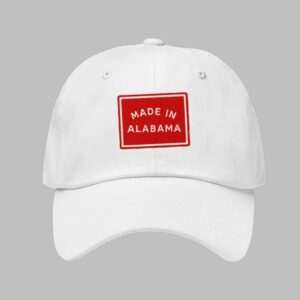
Jones recalled the campaign’s early look: bold red and white visuals that demanded attention. “We needed people to take Alabama seriously,” she said. As the brand matured, it evolved into a more refined and confident look. Jones added, “Businesses know Alabama is a serious contender.”
Looking ahead, the Department of Commerce hopes to make Made in Alabama even more inclusive.
“I want every partner—educators, researchers, investors and entrepreneurs—to see themselves in it,” Jones said. “No matter who you are or where you work, you should see a place for your ideas in Made in Alabama.”